article · 4 October 2026 · 4 min read
Targeting Schools in Lebanon: A Violation of International Humanitarian Law
A Legal Analysis on the Protection of Civilian Objects, War Crimes Qualification, and Accountability
By Jathwa Center for Legal Analysis، قسم الدراسات والتحليلات القانونية - مركز جذوة
Abstract
This article examines the severe legal implications of the damage and destruction inflicted upon over 470 educational facilities in Lebanon since March 2026, based on UNICEF field surveys. It provides a rigorous legal assessment of the protection afforded to schools, teachers, and students as civilian objects and persons under Articles 48, 51, 52, and 57 of Additional Protocol I (1977) to the Geneva Conventions. Furthermore, the study analyzes the conditions under which the intentional targeting of educational infrastructure constitutes a war crime pursuant to Article 8 of the Rome Statute of the International Criminal Court. Linking IHL rules with the Right to Education under Articles 28 and 38 of the 1989 Convention on the Rights of the Child, the paper underscores the critical imperative of independent investigations and international accountability mechanisms to prevent impunity.
The damage and destruction of schools and educational facilities in Lebanon during hostilities raise serious concerns regarding compliance with international humanitarian law, particularly the rules governing the protection of civilians and civilian objects during armed conflict.
As a general rule, schools are considered civilian objects and may not be targeted unless, under specific circumstances, they become military objectives in accordance with international humanitarian law. Students and teachers are likewise entitled to the protection afforded to civilians.
Schools Affected by Hostilities
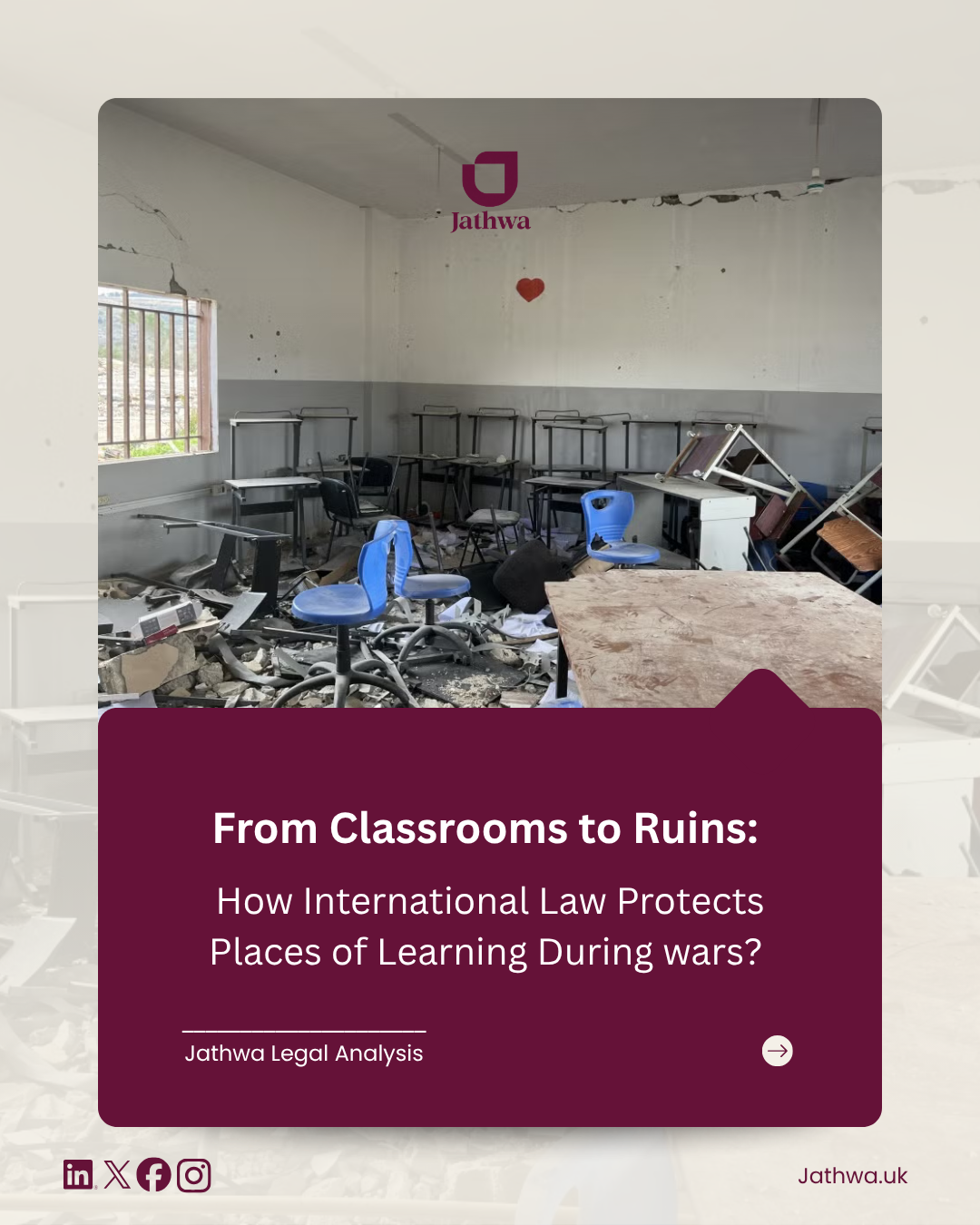
Since the escalation of hostilities in Lebanon in March 2026, the education sector has sustained extensive damage.
According to UNICEF, a survey covering 1,089 educational facilities found that 436 facilities had been damaged, while 37 had been completely destroyed. The impact extends beyond physical infrastructure, disrupting education and threatening children’s access to a safe learning environment.
What Does International Humanitarian Law Provide?
The legal framework protecting schools and civilians is based on a number of fundamental rules of international humanitarian law.
Article 48 of Additional Protocol I of 1977 establishes the principle of distinction, requiring parties to an armed conflict at all times to distinguish between civilians and combatants, and between civilian objects and military objectives.
Article 51 of the same Protocol protects the civilian population against the dangers arising from military operations and prohibits making the civilian population and individual civilians the object of attack.
Article 52 provides general protection for civilian objects. It defines civilian objects as all objects that are not military objectives and prohibits attacks against them.
Under Article 57, parties to a conflict must take all feasible precautions in the planning and conduct of military operations to avoid, and in any event to minimize, incidental loss of civilian life, injury to civilians, and damage to civilian objects.
These rules apply to schools as civilian objects, unless the conditions required under international humanitarian law for their qualification as military objectives are met.
When Can an Attack Constitute a War Crime?
The Rome Statute of the International Criminal Court criminalizes, under certain circumstances, the intentional targeting of civilian objects.
Article 8(2)(b)(ii), in the context of international armed conflicts, establishes as a war crime the intentional directing of attacks against civilian objects- that is, objects that are not military objectives.
In the context of non-international armed conflicts, Article 8(2)(e)(i) of the Rome Statute likewise provides protection for civilian objects in the context of prohibited acts committed during such conflicts.
Whether a particular attack constitutes a war crime depends on the nature of the conflict, the facts and evidence established, and the applicable legal elements.
Protection of Children and the Right to Education
The protection of schools is particularly important because students and teachers are civilians in principle, and attacks on educational facilities can disrupt education and deprive children of a safe and stable learning environment.
The Convention on the Rights of the Child, adopted in 1989, requires States to respect and protect children's rights, including the right to education under Article 28. Article 38 further requires States to respect the relevant rules of international humanitarian law applicable to children in armed conflict.
Accordingly, the protection of schools during armed conflict is closely linked to the protection of civilians and children, as well as to ensuring the continuity of education.
The Need for Investigation and Accountability
The repeated damage to schools and educational facilities in Lebanon requires systematic documentation and, where there are indications that unlawful attacks may have occurred, independent and effective investigations.
Investigations should establish the nature of the facility targeted, the potential military objective, the precautions taken to protect civilians, and whether the anticipated harm to civilians and civilian objects was proportionate to the anticipated military advantage.
The importance of such investigations extends beyond establishing responsibility. They are also essential to preventing the recurrence of violations and strengthening compliance with international humanitarian law.
The protection of schools in Lebanon is not merely a matter of protecting buildings and infrastructure. It forms part of the broader legal framework protecting civilians, children, and civilian objects during armed conflict.
Articles 48, 51, 52 and 57 of Additional Protocol I provide a fundamental legal framework for assessing attacks affecting schools, while the Rome Statute establishes the circumstances in which the intentional targeting of civilian objects may constitute a war crime.
Where investigations establish that an unlawful attack has occurred, responsibility should be determined and those responsible held accountable in accordance with applicable law.
Protecting schools means protecting children, safeguarding their right to education, and ensuring that places of learning do not become additional casualties of armed conflict.
Legal References
Additional Protocol I to the Geneva Conventions of 1977, Articles 48, 51, 52 and 57.
Rome Statute of the International Criminal Court, Article 8.
Convention on the Rights of the Child, 1989, Articles 28 and 38.
Customary international humanitarian law relating to the protection of civilian objects.
International Committee of the Red Cross (ICRC).
United Nations Children’s Fund (UNICEF).
Get in touch
Citing or republishing our work
For press inquiries, citation requests, or republication permissions, our team welcomes correspondence from scholars, journalists, and aligned organisations.