article · 14 October 2026 · 4 min read
Targeting Journalists in Lebanon: A Violation of International Humanitarian Law and a Call for Accountability
A Legal Analysis of Press Protection under IHL and the Conditions Constituting War Crimes
By Prepared by the Legal Research Department (Based on documentation from Human Rights Watch, Amnesty International, ICRC, UNESCO, and the Gulf Centre for Human Rights)
Abstract
This article examines the escalating risks faced by media professionals in Lebanon, highlighting key incidents of targeting journalists while performing their duties. It analyzes the protective legal framework under International Humanitarian Law—specifically Article 79 of Additional Protocol I—and outlines the elements that elevate intentional attacks against civilian journalists to war crimes, stressing the imperative for independent investigations and accountability.
Targeting Journalists in Lebanon: A Violation of International Humanitarian Law
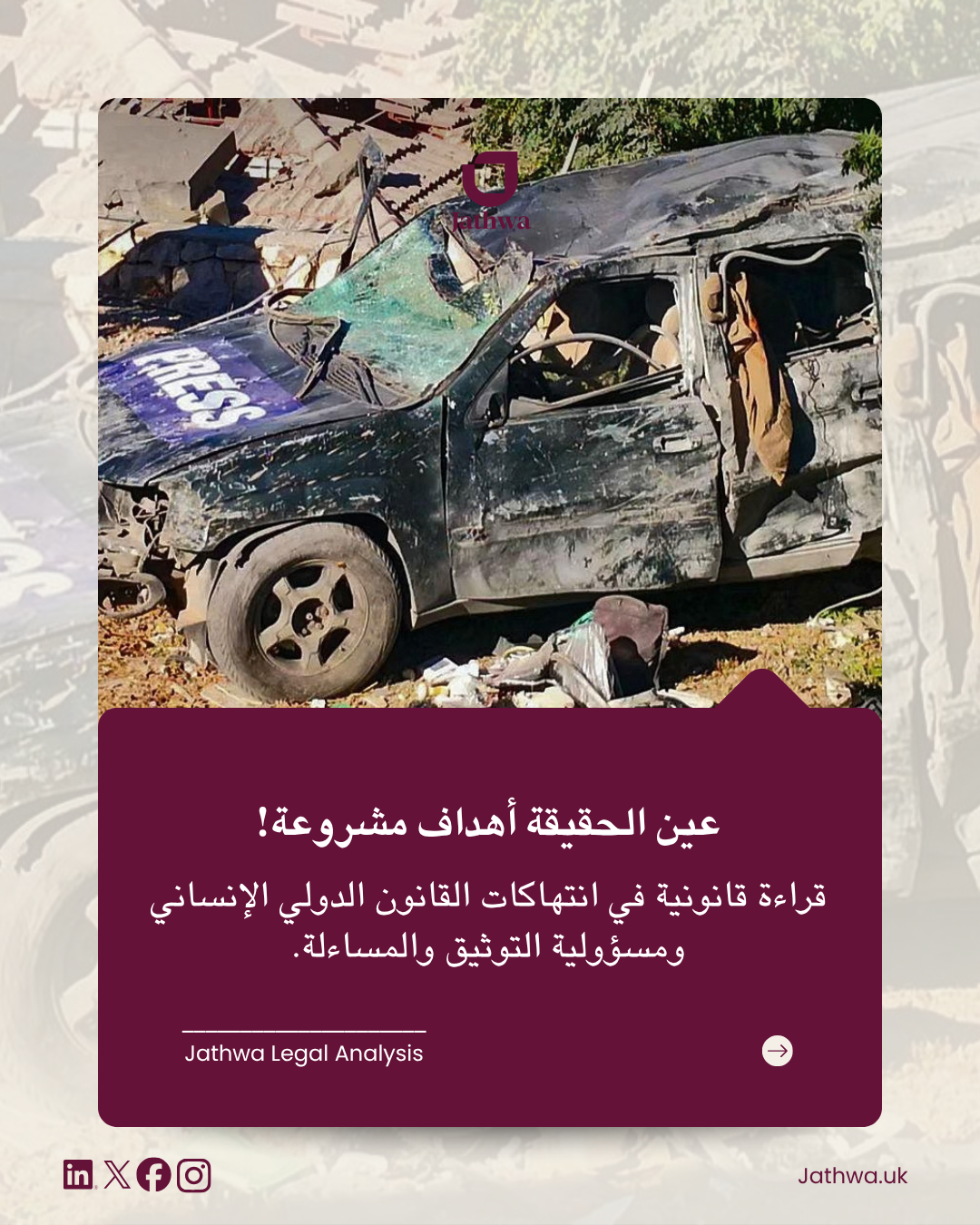
The increasing number of journalists killed or injured while covering events in Lebanon raises serious concerns regarding compliance with international humanitarian law and the protection afforded to media professionals during armed conflict.
Journalists, provided that they do not take a direct part in hostilities, are entitled to the protection afforded to civilians under international humanitarian law and may not be targeted merely for carrying out their journalistic duties.
Journalists Affected by the Conflict
Since October 2023, southern Lebanon has witnessed a number of incidents affecting journalists while they were carrying out their professional duties.
On 13 October 2023, Reuters videographer Issam Abdallah was killed and six other journalists were injured in the area of Alma al-Shaab. The injured journalists were Thaer Al-Sudani, Maher Nazeh, Christina Assi, Dylan Collins, Carmen Joukhadar, and Elie Brakhia.
Investigations by Amnesty International and Human Rights Watch raised serious concerns regarding the circumstances of the attack and called for an investigation into whether the incident constituted a potential attack against civilians.
On 21 November 2023, Al Mayadeen correspondent Farah Omar and cameraman Rabih Maamari, together with their colleague Hussein Aqil, were killed in the Tayr Harfa area of southern Lebanon.
The risks facing media workers continued into 2026. On 28 March, journalists Ali Shoeib, Fatima Ftouni and Mohammad Ftouni were killed in southern Lebanon while carrying out their journalistic work. The incident prompted calls for an investigation into the circumstances of their deaths and for responsibility to be established.
According to the Gulf Centre for Human Rights, the killing of several journalists during strikes in Lebanon in March and April 2026 represents a serious escalation in the risks faced by media workers and raises questions regarding compliance with international humanitarian law.
What Does International Humanitarian Law Provide?
Civilian journalists are afforded the general protection applicable to civilians under international humanitarian law.
Article 79 of Additional Protocol I of 1977 specifically recognizes the protection of journalists engaged in dangerous professional missions in areas of armed conflict.
This protection does not mean that journalists are immune from the dangers of war. However, they may not be made the object of attack merely because they are performing their professional duties.
Parties to an armed conflict are also required to respect the principle of distinction between civilians and military objectives and to take all feasible precautions to avoid or minimize harm to civilians.
When Can Such an Attack Constitute a War Crime?
If an investigation establishes that a civilian journalist was intentionally targeted despite not taking a direct part in hostilities, such conduct may constitute a serious violation of international humanitarian law and, depending on the circumstances and applicable legal elements, may amount to a war crime.
The legal assessment must take into account the nature of the conflict, the status of the journalist at the time of the incident, the circumstances of the attack, the available evidence, and the applicable rules of international humanitarian law.
The Need for Investigation and Accountability
The repeated killing and injury of journalists in Lebanon requires independent, transparent and effective investigations capable of establishing the circumstances of each incident and determining responsibility.
Such investigations are important not only to provide justice to victims and their families, but also to prevent the recurrence of violations and combat impunity.
Protecting journalists also means protecting the public's right to know. Journalists play a fundamental role in documenting events, providing information and reporting alleged violations, particularly in conflict-affected areas where access may be severely restricted.
Conclusion
The protection of journalists is not a professional privilege; it forms part of the protection afforded to civilians under international humanitarian law.
The series of incidents affecting journalists in Lebanon since 2023, including the killing of journalists in 2026, raises serious human rights and humanitarian law concerns that warrant investigation, documentation and accountability.
Where investigations establish that civilian journalists were subjected to deliberate or unlawful attacks, identifying those responsible and holding them accountable should form an essential part of the legal response, helping to safeguard journalism and the public's right to know while reducing impunity.
Get in touch
Citing or republishing our work
For press inquiries, citation requests, or republication permissions, our team welcomes correspondence from scholars, journalists, and aligned organisations.