article · 22 September 2026 · 6 min read
A fire the law cannot extinguish
White Phosphorus and the Reality of International Protection in South Lebanon
By JATHWA — Legal Unit Jathwa Institute for Legal and Strategic Studiesand Training
Contents
The documented use of white phosphorus munitions in southern Lebanon in 2026 has once again brought into focus a legal issue that extends beyond the legality of using a particular weapon, raising broader questions about the adequacy of the existing international framework in addressing weapons that inflict severe incendiary effects on human beings and the civilian environment.
In its report published in September 2026, in cooperation with the International Human Rights Clinic at Harvard Law School, Human Rights Watch examined the humanitarian effects of white phosphorus, as well as what it considers to be gaps in the international legal framework governing incendiary weapons.
01First: Lebanon Through the Lens of the Report
The situation in southern Lebanon is particularly significant in this debate because it provides a practical example of the problem identified in the report concerning the gap in the international regulation of weapons with incendiary effects.
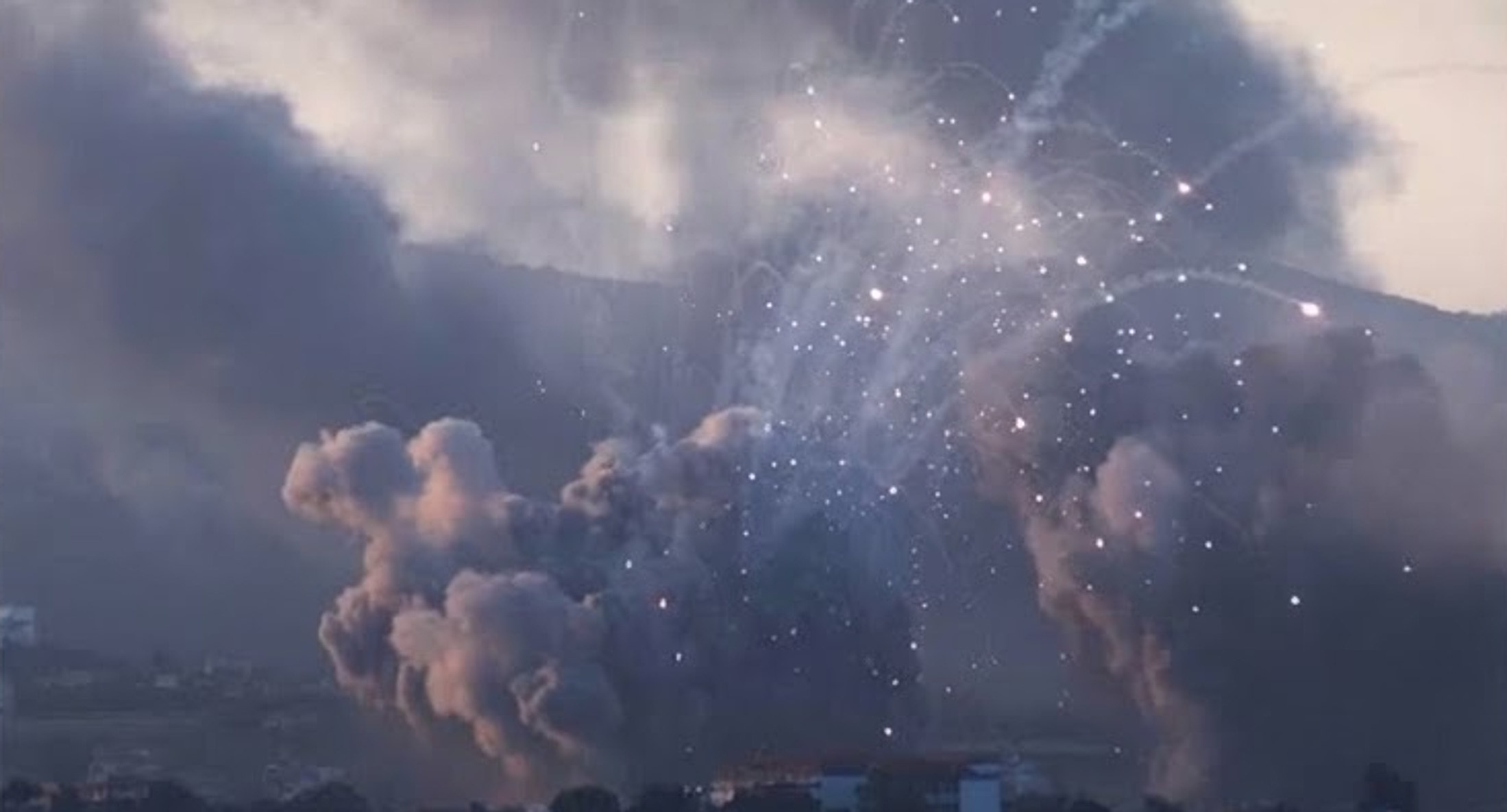
Human Rights Watch verified the use by Israeli forces of white phosphorus artillery shells over homes in the town of Yohmor, southern Lebanon, on March 3, 2026. The organization documented the use of at least two munitions and geolocated eight photographs from the incident. Some of the images showed firefighting efforts on the roofs of homes and around a vehicle, as well as smoke rising from the balconies of one of the houses.
The incidents addressed in the report are not limited to this particular event. According to research conducted by Ahmad Baydoun, a researcher at TU Delft who has been documenting the use of white phosphorus in Lebanon, 22 incidents involving the use of white phosphorus in Israeli attacks in southern Lebanon between March and May 2026 were verified, involving 33 munitions. The locations of 17 of these incidents were identified in Khiam, Arnoun, Yohmor, and Zawtar, and Human Rights Watch subsequently independently verified and geolocated them.
The archive compiled by Baydoun also documents a total of 286 “strikes” or explosions involving white phosphorus munitions in southern Lebanon between October 2023 and May 2026. The report explains that these strikes correspond to 189 separate incidents.
According to the report, these incidents reflect part of the humanitarian problem posed by white phosphorus munitions, particularly when they are used in populated areas. The report concludes that the use of white phosphorus munitions that burst in the air over populated areas is indiscriminate and therefore violates international humanitarian law.
The Lebanese case reveals a potential gap between the design purpose of a weapon and the actual humanitarian consequences of its use. It is this gap that underpins the report’s examination of whether the existing rules of international humanitarian law are sufficient, and its consideration of the need for more specific rules to protect civilians from weapons with incendiary effects, regardless of the primary purpose for which the munition was designed.
02Second: The Dual Nature of the Problem
White phosphorus is used militarily, among other purposes, for smoke screening, concealment, illumination, and marking locations. However, its physical properties make it highly combustible when exposed to oxygen, and this characteristic can cause deep and painful burns, severe respiratory and bodily injuries, and health, psychological, and social consequences that may last a lifetime.
From a legal perspective, merely characterizing the substance as “chemical” is not sufficient to establish the applicability of the international legal regime prohibiting chemical weapons. In this context, the legal classification depends on the purpose for which the substance is used and the nature of its intended effects.
Accordingly, white phosphorus munitions are not regulated as chemical weapons under the Chemical Weapons Convention when their use is based on their incendiary or smoke-producing properties.
03Third: Protocol III and the Definition Gap
Protocol III of 1980, annexed to the Convention on Certain Conventional Weapons, constitutes one of the principal international treaty frameworks governing incendiary weapons.
The difficulty, however, lies in the scope of the definition of an incendiary weapon and in the criterion that links the applicability of the Protocol to the primary purpose for which a weapon was designed.
Some white phosphorus munitions are designed primarily for smoke or illumination purposes, even though their use may produce a severe incendiary effect.
Accordingly, the legal issue is not that Protocol III “does not apply at all” to white phosphorus, but rather that its current wording does not clearly encompass all forms of munitions and uses that produce incendiary effects.
This is where the gap between the legal classification of a weapon and the actual humanitarian consequences of its use becomes apparent.
04Fourth: Distinguishing Between the Means and the Humanitarian Outcome
International humanitarian law is not based solely on the classification of weapons; it is also founded on a set of principles intended to limit human suffering during armed conflicts.
Among the most prominent of these principles are:
The principle of distinction;
The principle of proportionality;
The obligation to take feasible precautions; and
The prohibition of causing unnecessary suffering or superfluous injury.
Accordingly, an assessment of the use of white phosphorus should not be confined to the question of whether the weapon technically falls within a particular definition. It should also consider where the weapon was used, how it was used, the military objective, and the foreseeable effects on civilians and civilian objects.
05Fifth: The Martens Clause and the Ethical Limits of Law
The Martens Clause assumes particular importance in this context. The absence of an express treaty rule does not mean that particular conduct falls outside the humanitarian considerations of international law.
The Martens Clause preserves the relevance of the principles of humanity and the dictates of public conscience in circumstances where legal protection has not been fully established through a specific treaty provision.
From this perspective, the report raises a question that goes beyond legal technicalities:
Can the existing international legal framework remain adequate when practice reveals a weapon capable of causing such a high degree of suffering, while the wording of existing rules allows it to potentially fall outside their scope in certain circumstances of use?
06Sixth: Toward the Development of International Rules
The issue of white phosphorus reveals a broader challenge in disarmament law and international humanitarian law:
What happens when the means and methods of warfare advance faster than the rules governing them?
Addressing this challenge requires more than merely interpreting existing provisions. It calls for an examination of whether there is a need to develop clearer and more comprehensive international rules concerning weapons with incendiary effects, ensuring that differences in a weapon’s design purpose do not weaken the humanitarian protection that the law is intended to provide.
According to the report, the highest level of humanitarian protection could be achieved through the adoption of stronger international rules, including consideration of a ban on the production, transfer, stockpiling, and use of such weapons.
07Conclusion
The legal issue does not lie solely in white phosphorus as a substance or weapon. Rather, it lies in the broader question of whether international humanitarian law is capable of bridging the gap between the classification of a weapon and the scale of suffering that its use can cause.
In armed conflicts, the protection of civilians should not depend on a definitional loophole or on the technical limitations of a treaty provision.
When the existing rule is insufficient to protect human beings, developing the rule becomes part of the international community’s responsibility.
Get in touch
Citing or republishing our work
For press inquiries, citation requests, or republication permissions, our team welcomes correspondence from scholars, journalists, and aligned organisations.