article · 23 September 2026 · 1 min read
Women and Children in the Crossfire
An overview of the official casualties among women and children in Lebanon based on Ministry of Public Health figures, addressing legal questions regarding civilian protection under International Humanitarian Law.
By Jathwa center for legal and strategic studies and training
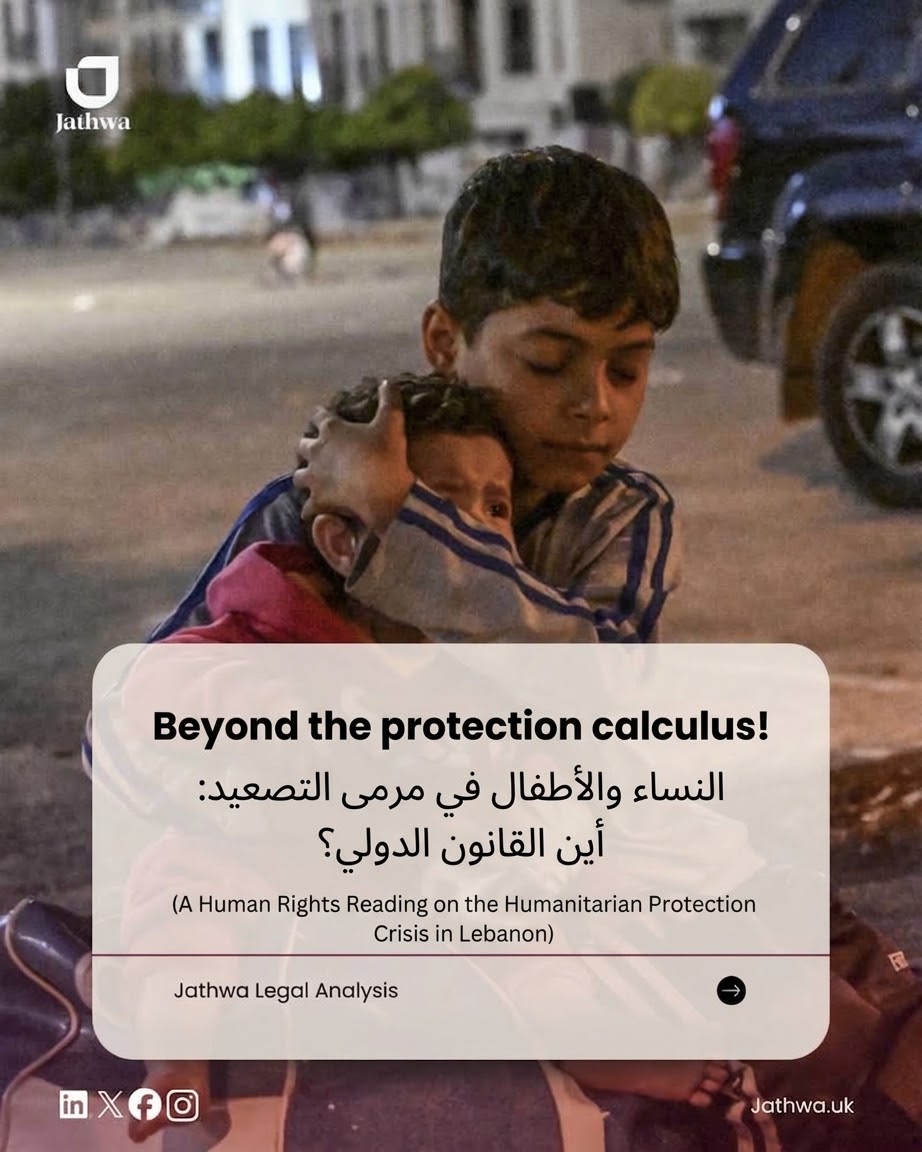
The Human Toll and Legal Questions in Lebanon
Since 2 March 2026, the official death toll in Lebanon has reached 4,383, with 12,406 people injured, according to the latest figures released by the Lebanese Ministry of Public Health.
The latest available data indicate that 339 women and 245 children have been killed, while 1,337 women and 957 children have been injured. These figures remain subject to change as the Israeli military operations continue.
These figures represent more than a human toll; they also raise legal questions concerning the extent to which the rules of international humanitarian law have been respected, particularly those relating to the protection of civilians, including women and children.
This protection is grounded in the Geneva Conventions of 1949, Additional Protocol I of 1977, and the Convention on the Rights of the Child of 1989.
This raises fundamental questions: How did these casualties occur? Were all feasible measures taken to protect civilians? And were the principles of distinction, proportionality, and precautions in attack observed during the Israeli military operations?
The figures document the scale of the human losses and provide an essential basis for examining potential legal responsibility. Any such determination, however, remains contingent upon the documentation of the facts and investigation into the circumstances of each individual incident.
Behind every number is a person, a family, and a life changed forever.
The protection of civilians is not a matter of choice; it is a legal obligation that remains in force even during armed conflict.
Related
Related publications
Get in touch
Citing or republishing our work
For press inquiries, citation requests, or republication permissions, our team welcomes correspondence from scholars, journalists, and aligned organisations.