article · 23 September 2026 · 1 min read
Healthcare Under Attack: Figures Raising Legal Questions
An overview of the Lebanese Ministry of Public Health figures on attacks targeting hospitals, medical personnel, and ambulances, accompanied by a legal assessment under International Humanitarian Law.
By Jathwa center for legal and strategic studies and training
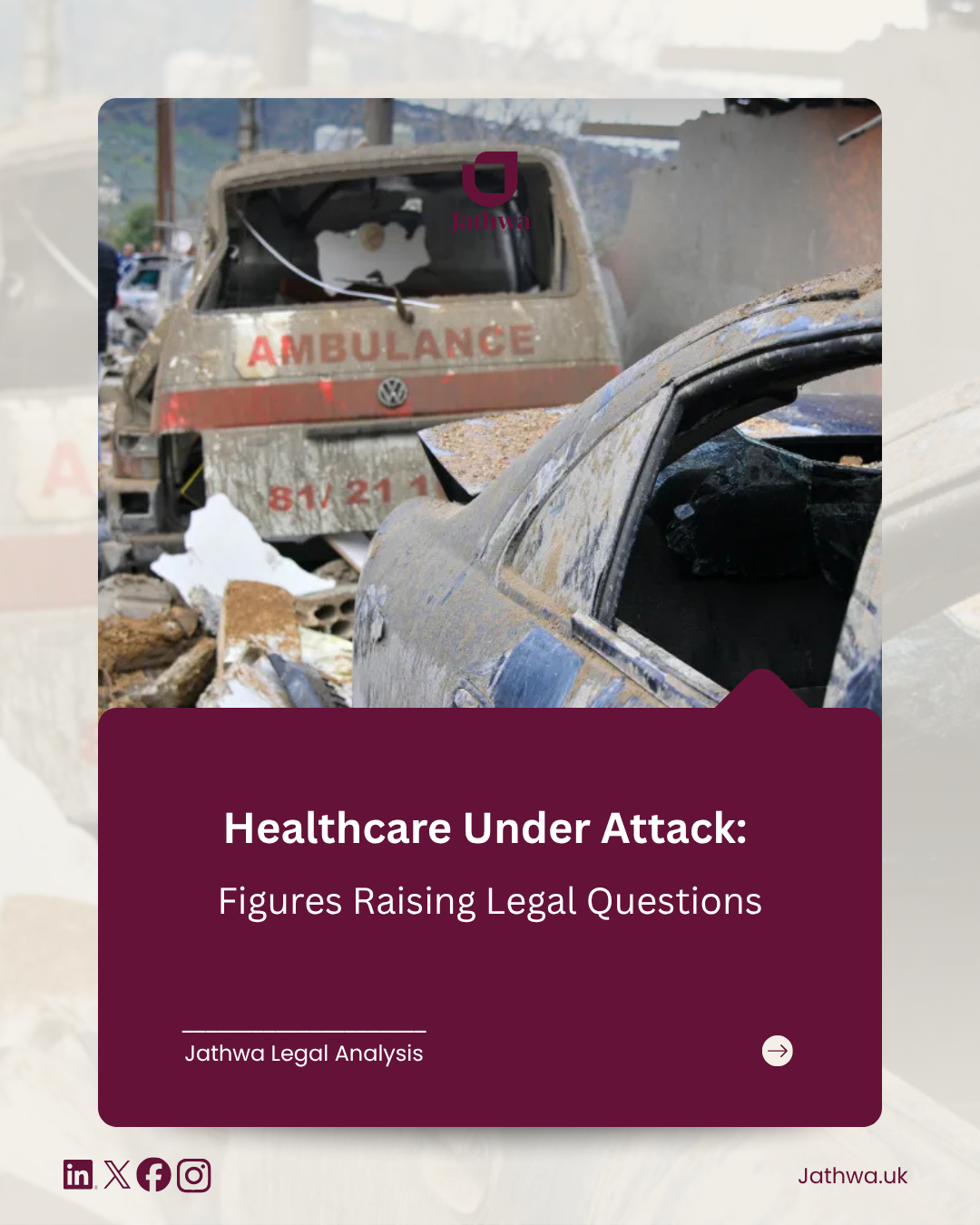
According to data released by the Lebanese Ministry of Public Health, 17 hospitals have been damaged, three hospitals have been forced to close, and 40 healthcare facilities have been targeted.
A total of 180 incidents involving attacks on ambulance and emergency medical teams have been recorded, while 184 medical vehicles have been damaged.
Among healthcare workers, the reported death toll stands at 135, including 130 members of ambulance and emergency medical teams and five medical and nursing staff.
A total of 416 injuries have also been reported, including 269 among ambulance and emergency medical teams and 147 among medical and nursing staff.
These figures cannot be viewed in isolation from the law.
During armed conflicts, international humanitarian law affords special protection to hospitals, medical units, medical personnel, and medical transport, and requires parties to the conflict to respect and protect them.
Article 18 of the Fourth Geneva Convention protects civilian hospitals, while Article 24 of the First Geneva Convention protects medical personnel. Article 35 provides protection for medical transport.
Articles 12, 15, and 21 of Additional Protocol I likewise affirm the protection of medical units, medical personnel, and medical vehicles.
Accordingly, attacks against protected facilities, personnel, and means of transport do not merely constitute violations of humanitarian rules; they may amount to war crimes where the requisite legal elements are established.
Related
Related publications
Get in touch
Citing or republishing our work
For press inquiries, citation requests, or republication permissions, our team welcomes correspondence from scholars, journalists, and aligned organisations.