article · 4 November 2026 · 5 min read
Electricity Bills Put Lebanon's Public Utilities at Risk of Blackout
EDL's Monday deadline for unpaid public-sector bills is nearing, with over $248 million owed and Beirut's airport on the cutoff list.
By Jathwa Center for Legal and Strategic Studies and Training
Electricity Bills Put Lebanon's Public Utilities at Risk of Blackout
Interior Ministry tops the list of defaulters, with the airport on the threat list for Monday
The deadline set by Électricité du Liban (EDL) for public administrations, institutions and municipalities that have not paid their dues expired on Monday. Unpaid amounts exceed $248 million, at a time when the company suffers a funding shortfall that hampers its ability to supply Lebanese citizens with electricity.
EDL sources say the board of directors has decided to apply the measure to all defaulters starting Monday morning, noting that the step also comes on the directive of the Energy Minister.
The Airport Crisis
Rafic Hariri International Airport experienced a power outage lasting many hours on Wednesday. Its management announced that it was now running on backup generators instead of the public grid, in order to maintain operations and keep work in its facilities and equipment as orderly as possible.
For its part, the Lebanese Air Transport Union (UTA) criticized on Saturday what it described as the Energy Ministry and EDL's persistence in a negative and vindictive approach toward a vital and strategic sector, calling on the ministry to recognize the extent of the damage that could be inflicted on Lebanon and its connection to the outside world.
The Energy Ministry rejected this accusation, charging the union with distorting the facts and evading financial obligations that fall on the airport's management. It clarified that its dispute is not with the airport as the country's gateway to the world and an essential facility for the economy, but with the evasion of financial responsibilities. It maintained that demanding payment is neither a threat nor a targeting, but a legal and financial duty and a condition for the continuity of the public utility and the regularity of its services.
Was the Power Actually Cut?
Many linked Wednesday's outage to the carrying out of the threats, but sources at the Energy Ministry denied this, stressing that the cause was purely technical and has been resolved. However, they kept open the possibility of cutting power to the airport on Monday, because those concerned have not contacted the ministry or EDL to settle the dues of the General Directorate of Civil Aviation, which exceed $22.8 million. They added that several parties had made contact to avoid the cutoff, but no payments have arrived yet.
The Palestinian Camps
Non-payment is not limited to administrations. EDL sources estimate the dues owed by the Palestinian camps at between $60 and $70 million under the new tariff, which rose after the local currency's collapse amid the economic crisis since 2019. This amount does not include old-tariff bills that EDL has not yet issued, which are separate dues.
Director General Kamal Hayek held meetings with the Palestinian ambassador, who, sources said, was responsive and promised to follow up on the file. EDL also requested a direct meeting with representatives of the factions, foremost among them Fatah and Hamas, to agree on a mechanism and schedule for payment. Even so, the decision to cut electricity to the camps remains on the table in parallel with the negotiations.
Two Opposing Views
A source at the Electricity Regulatory Authority believes that EDL has the right to cut power to defaulters, whether individuals, institutions or administrations, after they were given repeated grace periods without responding, and that, amid expensive oil and technical and non-technical losses, the company is compelled to take strict measures to preserve the stability of the grid.
By contrast, Ghassan Beydoun, former Director General of Exploitation and an expert at the Lebanese Institute for Market Studies, strongly opposes this approach. He considers that cutting power to any public facility, such as the airport, water, telecommunications or public hospitals, amounts to a crime because of the danger it poses to the functioning of these facilities, to aircraft movements, and possibly to the lives of passengers. He believes EDL shares responsibility, because of its delay in issuing bills, its failure to pay what it owes, and its failure to lower the tariff when the price of a barrel of Brent gradually fell from $110 to $70, when, in his view, it should have dropped by about 35 percent in the years before the Gulf war and the Strait of Hormuz crisis.
Beydoun adds that EDL collects a fixed meter fee without providing round-the-clock supply as its operating regime requires, which introduced into its bills amounts that were not owed and should have been deducted from the bills of past years since 2023. He notes that the 2026 budget currently being implemented, in principle, has no room to pay a previous year's bills except in special cases. He believes EDL has transferred its financial chaos to the state budget and the budgets of public utilities, and that addressing this begins with rebuilding trust between it and its subscribers, whether citizens, administrations, institutions or economic sectors exhausted by the electricity crisis.
Official Figures
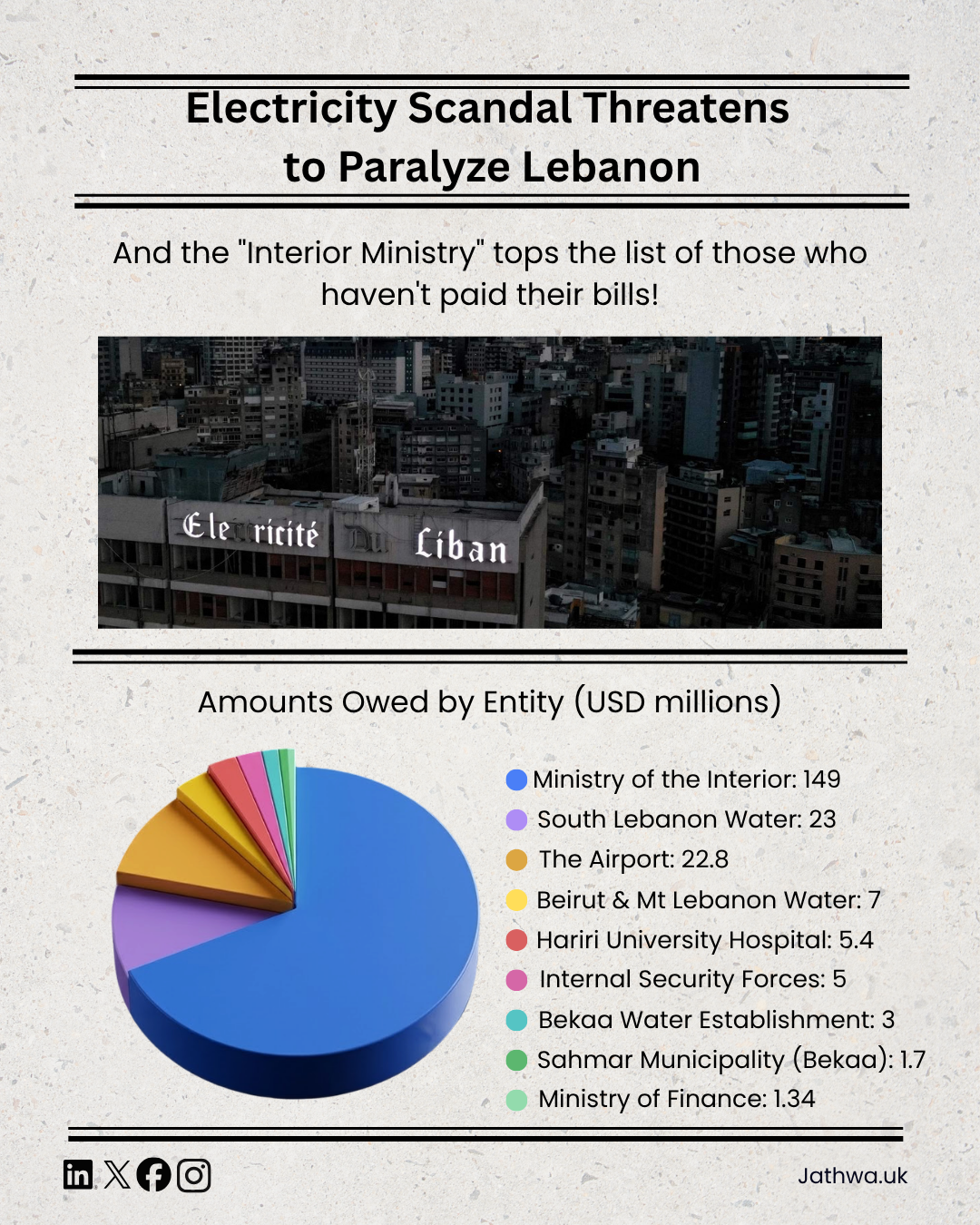
Asharq Al-Awsat obtained the official figures for dues owed by a large number of entities, including:
Ministry of Interior: about $149 million
South Lebanon Water Establishment: $23 million
Beirut and Mount Lebanon Water Establishment: $7 million
Rafic Hariri University Hospital: $5.4 million
General Directorate of the Internal Security Forces: $5 million
Bekaa Water Establishment: $3 million
Sahmar Municipality in the Bekaa: $1.7 million
Ministry of Finance: $1.34 million
Get in touch
Citing or republishing our work
For press inquiries, citation requests, or republication permissions, our team welcomes correspondence from scholars, journalists, and aligned organisations.