article · 16 November 2026 · 11 min read
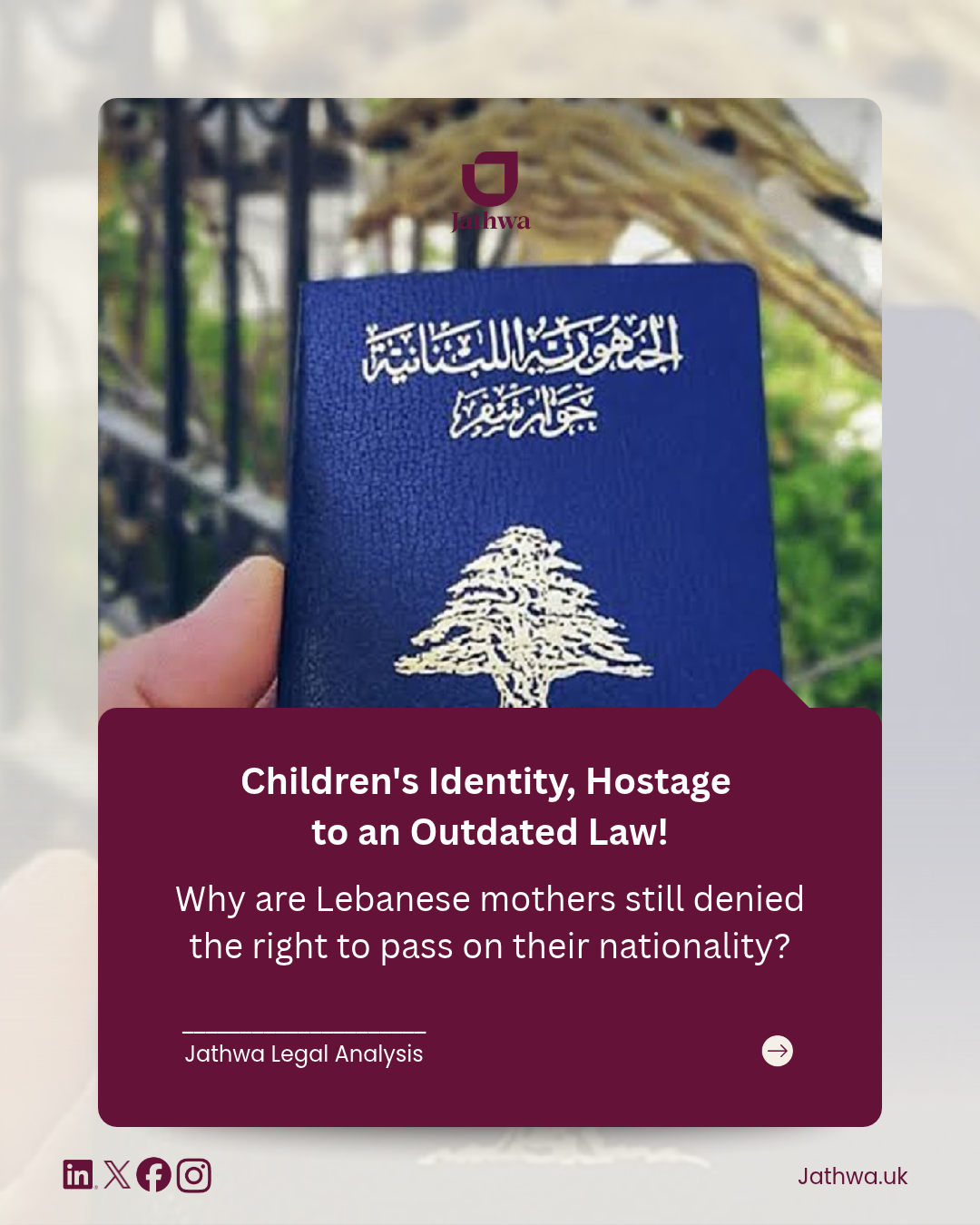
The Right of Lebanese Women to Pass Nationality to Their Children
A Legal Report in Light of International Human Rights Law and Lebanese Legislation
Contents
Abstract
This report examines the denial of Lebanese women married to foreigners the right to pass their nationality to their children, unlike Lebanese men. It analyzes the relevant constitutional and international framework, the impact of this discrimination on children, including the risk of statelessness, and proposes legislative reforms that ensure equality and protect the best interests of the child.
Nationality is not merely an official document. It is a fundamental part of a person's identity and sense of belonging to their homeland, and one of the pillars that determine their legal status and rights. From this perspective, the problem of denying Lebanese women married to foreigners the right to pass their nationality to their children comes to the fore, unlike Lebanese men, who enjoy this right without discrimination.
The impact of this discrimination is not limited to undermining equality between women and men. It extends to children, who may face legal and social difficulties, reaching in some cases the risk of statelessness.
On this basis, this report examines the Lebanese and international legal framework governing the right to nationality, in order to assess the compatibility of Lebanese legislation with the principles of equality, non-discrimination and the best interests of the child. It also reviews avenues for legislative reform that would guarantee Lebanese women's right to pass on their nationality and safeguard their children's right to identity, belonging and legal stability.
Nationality is a right tied to the human being and their dignity, and a parent's gender should never be a reason to diminish a child's right to belong to their mother's homeland.
01I. General Framework of the Issue
The legal problem in Lebanese nationality law lies in the inability of Lebanese women married to foreigners to pass their nationality to their children on an equal footing with Lebanese men, who may pass their nationality to their children regardless of the mother's nationality.
This rule raises legal questions relating to gender equality, non-discrimination and the child's right to acquire a nationality, as well as its repercussions on legal identity and on social and family stability.
The effects of this discrimination are not limited to women's legal status. They extend to their children, who may face legal and administrative difficulties because they do not acquire Lebanese nationality from their mothers, even where they have close family and social ties to Lebanon.
02II. International Legal Basis
This analysis rests on a set of international and regional instruments affirming the right to nationality, equality and non-discrimination, most notably:
Universal Declaration of Human Rights (1948): in particular Articles 2 and 7 on equality and non-discrimination, and Article 15, which recognizes the right to a nationality.
International Covenant on Civil and Political Rights (1966): in particular Articles 2, 3, 24 and 26, which affirm equality between men and women, prohibit discrimination, and recognize the child's right to acquire a nationality.
Convention on the Rights of the Child (1989): in particular Articles 2, 3, 7 and 8, which protect the child from discrimination and enshrine the best-interests principle and the rights to nationality and legal identity.
International Convention on the Elimination of All Forms of Racial Discrimination (1965): in particular Article 5, which guarantees equality in the enjoyment of the right to nationality without racial discrimination.
Arab Charter on Human Rights (2004): in particular Article 29, which recognizes the right to nationality and calls on States Parties to take appropriate measures to allow a child to acquire their mother's nationality, taking into account the child's best interests. Lebanon acceded to this Charter in 2011.
International Covenant on Economic, Social and Cultural Rights: which provides a basis for protecting children's economic and social rights and preventing discrimination in their enjoyment.
Read together, these instruments provide a legal basis for reviewing the compatibility of Lebanese legislation with the State's human rights obligations.
03III. The Position of Lebanese Legislation
The principle of equality in Lebanese law is not grounded only in international treaties. It is also rooted in the Lebanese Constitution. Paragraph (c) of the Preamble affirms that Lebanon is a parliamentary democratic republic founded on respect for public freedoms, foremost among them freedom of opinion and belief, and on social justice and equality of rights and duties among all citizens without discrimination or preference.
Article 7 further provides that all Lebanese are equal before the law, enjoy civil and political rights, and bear public obligations and duties without distinction.
From these two provisions arises the question of whether discrimination between women and men in passing nationality to children is consistent with the constitutional principle of equality, since denying the Lebanese mother a right enjoyed by the Lebanese father raises an issue of equality in citizens' rights and legal status. The Preamble and Article 7 are therefore a key constitutional reference in assessing nationality legislation, alongside Lebanon's international human rights obligations.
The basic rules governing Lebanese nationality date back to Decision No. 15 of 19 January 1925, which relies essentially on paternal descent for acquiring Lebanese nationality. Under its Article 1, any person born to a Lebanese father acquires Lebanese nationality, while the Lebanese mother, upon marrying a foreigner, is generally not granted the same right. This difference entrenches legislative discrimination between men and women in passing nationality to children.
That said, Lebanese legislation is not without exceptional cases of acquiring nationality through the mother, particularly under Article 2, which addresses certain cases of children born out of wedlock, and other special provisions. The core problem is therefore the absence of general equality between mother and father in passing nationality by descent, not the complete absence of any legal possibility of acquiring nationality through the mother.
04IV. Legal Effects on Children
The effects of denying Lebanese mothers the right to pass on their nationality vary according to the father's nationality and the law governing the acquisition of that nationality. Three main cases can be identified:
Case 1: A foreign father who can pass on his nationality. The child acquires the father's nationality under foreign law but remains denied Lebanese nationality from the mother under the general rule, which raises the question of equality and non-discrimination.
Case 2: A foreign father whose nationality cannot pass to the child. The child may face a gap in legal protection, especially if born outside Lebanon with no other means of acquiring a nationality. If born inside Lebanon, the possible application of paragraph 2 of Article 1 of Decision No. 15/1925 should be examined, according to its conditions.
Case 3: A father of unknown nationality or a stateless father. The likelihood of the child being stateless increases, particularly if born outside Lebanon and the father's nationality cannot be proven or another nationality acquired.
These cases show that the problem is not only whether an alternative foreign nationality exists, but also equality in passing on nationality and ensuring that no child is left without a recognized nationality.
05V. The Position of International Bodies
International human rights bodies have shown direct interest in the problem of Lebanese nationality law. The Committee on the Rights of the Child has called for amending Lebanese legislation to guarantee equality between women and men in passing nationality to children, while providing safeguards for children at risk of statelessness.
The Committee on the Elimination of Racial Discrimination, in its 2021 concluding observations on Lebanon, also addressed the legislative denial of Lebanese women married to foreigners the right to pass their nationality to their children, and called for this discrimination to be addressed.
These positions are particularly significant because they confirm that the matter is not merely a domestic debate, but one tied to Lebanon's fulfillment of its international obligations.
06VI. Legal Assessment
The continued reliance on paternal descent alone as the general rule for acquiring Lebanese nationality raises a serious problem in light of the principles of equality and non-discrimination. This is particularly evident when Decision No. 15/1925 is read together with Articles 2, 3 and 26 of the ICCPR, Articles 7 and 8 of the Convention on the Rights of the Child, and Article 29 of the Arab Charter on Human Rights.
Discrimination in passing on nationality may also, in some cases, expose children to the risk of statelessness or weaken the stability of their legal and social status.
Legally, a distinction must be drawn between being denied the mother's nationality and statelessness: not every child born to a Lebanese mother and a foreign father is stateless. Nevertheless, preventing mothers from passing on their nationality remains a separate issue concerning legal equality and the rights of women and children.
07VII. Exceptions in Lebanese Law
For legal accuracy, it must be noted that Lebanese legislation is not without exceptional cases in which nationality may pass through the mother. The most notable are:
Article 2 of Decision No. 15/1925: addresses the acquisition of Lebanese nationality by a child born out of wedlock under specific rules relating to the priority of establishing filiation, or its establishment in a single contract or judgment.
Article 4: addresses the acquisition of nationality by the wife and adult children in the context of the naturalization of the husband, father or mother, and also contains special provisions for minor children in certain circumstances.
It would therefore be inaccurate to say that Lebanese law prevents the transmission of nationality through the mother in all circumstances. Rather, the general rule does not grant a Lebanese mother married to a foreigner the same right granted to a Lebanese father.
08VIII. Legislative Recommendations
In light of this legal analysis, the following recommendations are proposed:
Amend Decision No. 15/1925 to establish equality between father and mother in passing Lebanese nationality to children.
Enable a child born to a Lebanese mother and a foreign father to acquire Lebanese nationality by descent, under conditions similar to those applied to a Lebanese father.
Adopt special legal safeguards for children at risk of statelessness, regardless of their place of birth.
Simplify procedures for birth registration and for proving parentage and nationality.
Introduce transitional provisions to address the legal status of children of Lebanese women born before the law is amended.
Align Lebanese legislation and administrative procedures with international obligations on equality and children's rights.
Conduct a national study to determine the legal and social situation of children of Lebanese women married to foreigners, and to identify cases at risk of statelessness.
09IX. Conclusion
The question of Lebanese women passing their nationality to their children is not merely a social demand or a political debate about amending an old law. It is a legal issue bound up with the concepts of citizenship, equality, the right to nationality and the protection of the child's legal identity.
A law that grants fathers the right to pass their nationality to their children while denying mothers the same right raises a fundamental question about the legal basis for this discrimination and its compatibility with the principles of equality and non-discrimination to which Lebanon has committed itself internationally.
Protecting children from the risks of statelessness also requires that their ability to acquire a nationality not remain exclusively dependent on the father's nationality, particularly where the mother is Lebanese and obstacles prevent the child from acquiring another nationality.
Reform of the Lebanese nationality law should therefore begin with a comprehensive review of the legislation that takes into account Lebanon's international obligations, safeguards the rights of Lebanese women, and places the best interests of the child at the heart of the legislative response.
Key Legal References
Decision No. 15 of 19 January 1925 on Lebanese nationality, as amended.
The Lebanese Constitution, in particular the Preamble and Articles 6 and 7.
Universal Declaration of Human Rights (1948).
International Covenant on Civil and Political Rights (1966).
International Covenant on Economic, Social and Cultural Rights (1966).
International Convention on the Elimination of All Forms of Racial Discrimination (1965).
Convention on the Elimination of All Forms of Discrimination against Women (1979).
Convention on the Rights of the Child (1989).
Arab Charter on Human Rights (2004).
The 1954 and 1961 Conventions on Statelessness.
Institutional References and Reports:
Committee on the Rights of the Child: Concluding Observations on Lebanon.
Committee on the Elimination of Racial Discrimination: Concluding Observations on Lebanon (2021).
Committee on the Elimination of Discrimination against Women: Concluding Observations on Lebanon.
United Nations High Commissioner for Refugees (UNHCR).
Norwegian Refugee Council (NRC): Guide to Children's Rights in Lebanon.
National Commission for Lebanese Women: studies on Lebanese nationality.
Get in touch
Citing or republishing our work
For press inquiries, citation requests, or republication permissions, our team welcomes correspondence from scholars, journalists, and aligned organisations.