article · 23 September 2026 · 5 min read
Targeting Places of Worship and Religious Symbols in South Lebanon: A Legal Classification under International Humanitarian Law
By Jathwa center for Legal and Strategic Studies and training
Contents
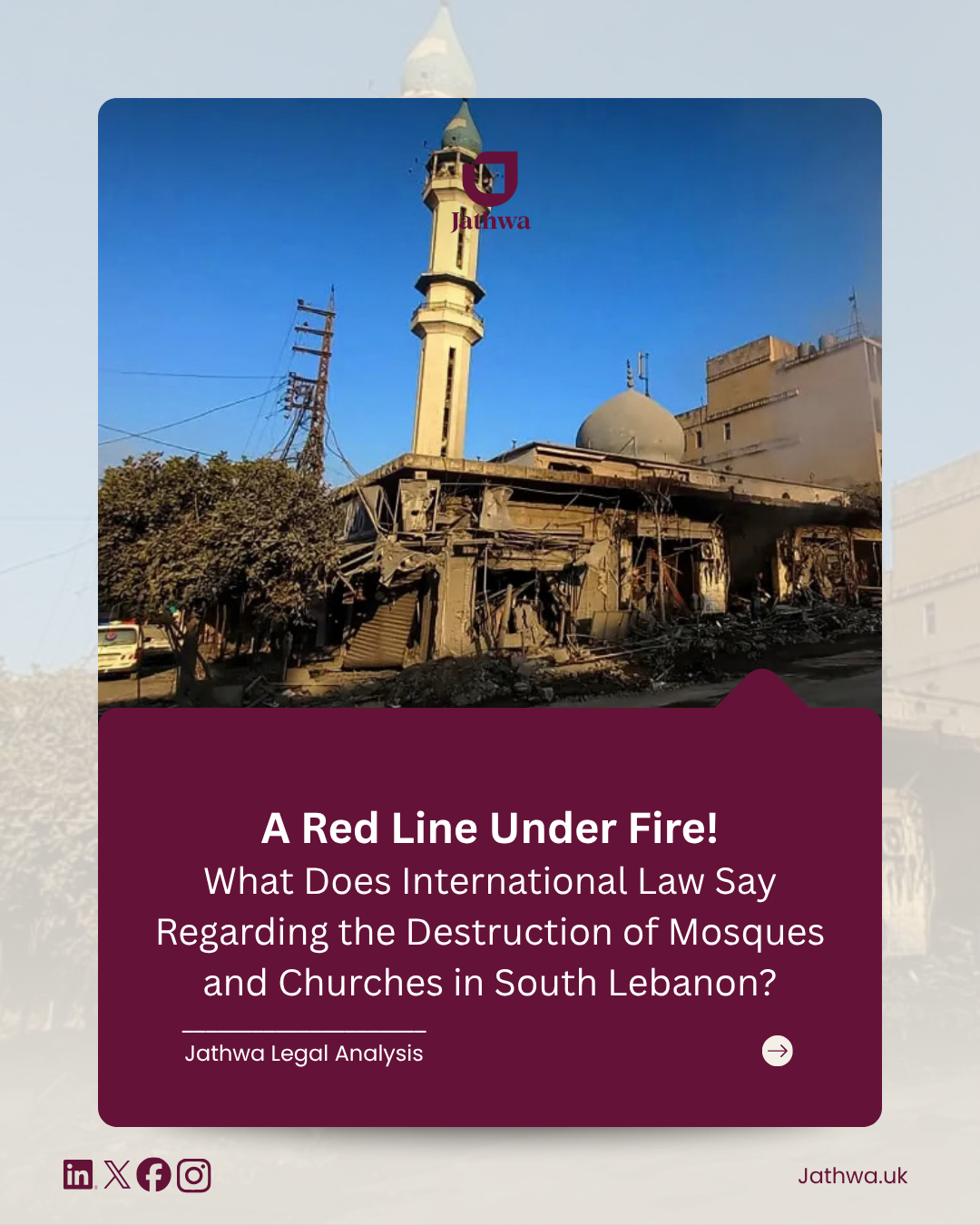
This analytical study examines grave violations against mosques, churches, and religious icons in Southern Lebanon throughout 2026, evaluating the applicable international humanitarian law framework and the classification of deliberate attacks on cultural and spiritual property as potential war crimes.
The damage and destruction inflicted upon places of worship, religious facilities, and sacred symbols in Southern Lebanon during ongoing military hostilities by the Israeli aggression raise profound concerns regarding compliance with International Humanitarian Law (IHL). Specifically, these actions challenge fundamental rules governing the protection of civilians, civilian objects, and property of cultural and spiritual value. As a general rule, mosques, churches, monasteries, and religious shrines enjoy the standard protection accorded to civilian objects and must not be targeted merely due to their location within an active military operational zone.
01I. The Legal Framework Protecting Places of Worship
021. Fourth Geneva Convention of 1949 – Article 27:
Guarantees protected persons the right to respect for their religious convictions and practices. It obligates parties to the conflict to treat protected persons humanely and safeguard them against all acts of violence, threats, and insults. The International Committee of the Red Cross (ICRC) emphasizes that respecting religious practices encompasses secure access to places of worship and freedom of worship.
032. Additional Protocol I of 1977 – Article 52:
Establishes the general protection of civilian objects, prohibiting attacks or reprisals against them. To forfeit civilian protection and become a legitimate military objective, an object must make an effective contribution to military action by its nature, location, purpose, or use, and its destruction must offer a definite military advantage. Under paragraph 3, in cases of doubt, objects normally dedicated to civilian purposes—such as places of worship—are presumed not to be used for military purposes.
043. Additional Protocol I of 1977 – Article 53:
Provides heightened protection for places of worship and cultural property. It explicitly prohibits committing acts of hostility directed against historic monuments, works of art, or places of worship which constitute the cultural or spiritual heritage of peoples, using them in support of the military effort, or making them the object of reprisals.
054. Customary International Humanitarian Law:
Rule 7: Reaffirms the principle of distinction between civilian objects and military objectives.
Rule 38: Mandates that special care must be taken in military operations to avoid damage to buildings dedicated to religion, art, science, education, or charitable purposes, unless they are military objectives.
Rule 104: Independently affirms the obligation to respect religious convictions and practices in both international and non-international armed conflicts.
065. 1954 Hague Convention for the Protection of Cultural Property:
Reinforces the protection of property of artistic, historical, or religious significance during armed conflict. Both Lebanon and Israel are states parties to the 1954 Hague Convention, generating clear legal obligations to abstain from targeting such heritage.
07II. Documented Violations Against Religious Sites and Symbols (2026)
Multiple documented incidents across Southern Lebanon in 2026 demonstrate systematic exposure of religious property to military attacks:
Destruction of a Mosque in Baraachit (March & April 2026):
Israeli airstrikes led to the complete destruction of a local mosque in Baraachit (Bint Jbeil district), amidst broader strikes affecting civilian infrastructure.
Desecration of a Statue of Jesus Christ in Debel (April 2026):
Video footage verified by major media outlets showed an Israeli soldier destroying a statue of Jesus Christ with a pickaxe in the town of Debel. The Israeli military admitted to the incident, announcing the dismissal of the involved soldiers, highlighting intentional desecration of religious symbols.
Destruction of Sheikh Ragheb Harb Mosque in Habsheet (April 21, 2026):
An airstrike completely destroyed the mosque and its surroundings in Habsheet during a declared temporary ceasefire, presenting a direct violation of Articles 52 and 53 of Additional Protocol I.
Maltreatment of Christian Places of Worship (April 25, 2026):
Reports documented Israeli soldiers filming mock wedding scenes inside a church in Deir Mimas, alongside damage to religious icons. Such actions constitute a dual violation of civilian property protections and Article 27 of the Fourth Geneva Convention regarding respect for religious dignity.
Demolition of the Monastery and School of the Salvatorian Sisters in Yaroun (May 2026):
Israeli military forces conducted controlled demolitions destroying the historic Salvatorian Sisters’ monastery, school, and adjacent chapel in Yaroun, alongside a local mosque, drawing international condemnation for the destruction of historical spiritual heritage.
Attack on a Mosque in Byblos / Jbeil (September 19, 2026):
The Mount Lebanon Endowments Department condemned an attack on a local mosque in Jbeil, adding to the documented series of infringements upon sacred sites.
08III. Legal Qualification: Do these Attacks Constitute War Crimes?
Based on available factual evidence, the targeted places of worship were exclusively civilian facilities dedicated to religious worship and community services, with no evidence establishing their use for military operations.
Consequently, intentionally directing attacks against buildings dedicated to religion and historic monuments—provided they are not military objectives—constitutes a grave violation of International Humanitarian Law and amounts to a war crime under Article 8(2)(b)(ix) of the Rome Statute of the International Criminal Court (ICC). Independent of physical destruction, acts of desecration and mockery within places of worship breach the fundamental duty to respect religious convictions under customary and treaty law.
09Conclusion
The protection guaranteed to places of worship during armed conflict is not merely symbolic; it represents an imperative legal obligation safeguarding human dignity and cultural heritage. The series of documented violations in Southern Lebanon throughout 2026 necessitates the activation of international legal mechanisms to hold perpetrators accountable and ensure full compliance with the law of armed conflict.
10References
Fourth Geneva Convention of 1949, Article 27.
Additional Protocol I of 1977, Articles 52, 53, and 57.
Customary International Humanitarian Law, Rules 38 and 104.
1954 Hague Convention for the Protection of Cultural Property in the Event of Armed Conflict.
International Committee of the Red Cross (ICRC).
United Nations Educational, Scientific and Cultural Organization (UNESCO).
Media and documentary sources cited in the factual accounts above.
Get in touch
Citing or republishing our work
For press inquiries, citation requests, or republication permissions, our team welcomes correspondence from scholars, journalists, and aligned organisations.